

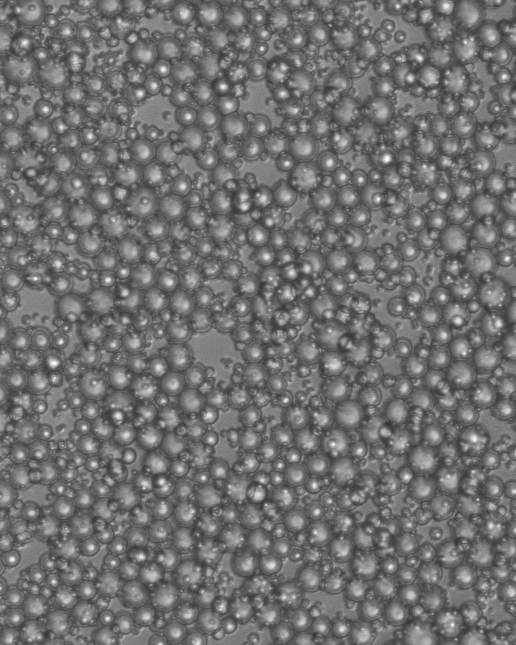
Using biologically-inspired approaches, proteins can be engineered to make functional biomaterials. Some polypeptides can undergo a liquid-liquid phase separation, either simple (1 component) or complex (2+ components), forming a dense, protein-rich phase that can then be used for purposes like injectable biomaterials or biosorbents. The properties of the dense phase can be tuned through a variety of different methods, and a fundamental understanding of the parameter space is critical for engineering better biomaterials. We also seek to engineer living biomaterials!
LEARN MORE ABOUT OUR SUSTAINABLE MATERIALS
Fisher, R.S.; Cheng, Y.; Ling, N.R.; Goessling, L.; Obermeyer, A.C.* Biomimetic approach to the formation of protein materials via complex coacervation of engineered polypeptides. ACS Synth. Biol., 2026, (15)2: 472–480. [link][bioRxiv preprint]
Ling, N.R.; Kotecha, A.; Obermeyer, A.C.* Coacervate Droplet Sequestration of Heterogeneous Nanoplastics with Elastin-like Polypeptides. Angew. Chem. Int. Ed., 2026. [link][bioRxiv preprint]
Pitt, B.N.; Guillen, D.; Obermeyer, A.C.* Catalytic bacterial nanocellulose composite that captures and degrades PET microplastics. bioRxiv, 2026. [bioRxiv preprint]